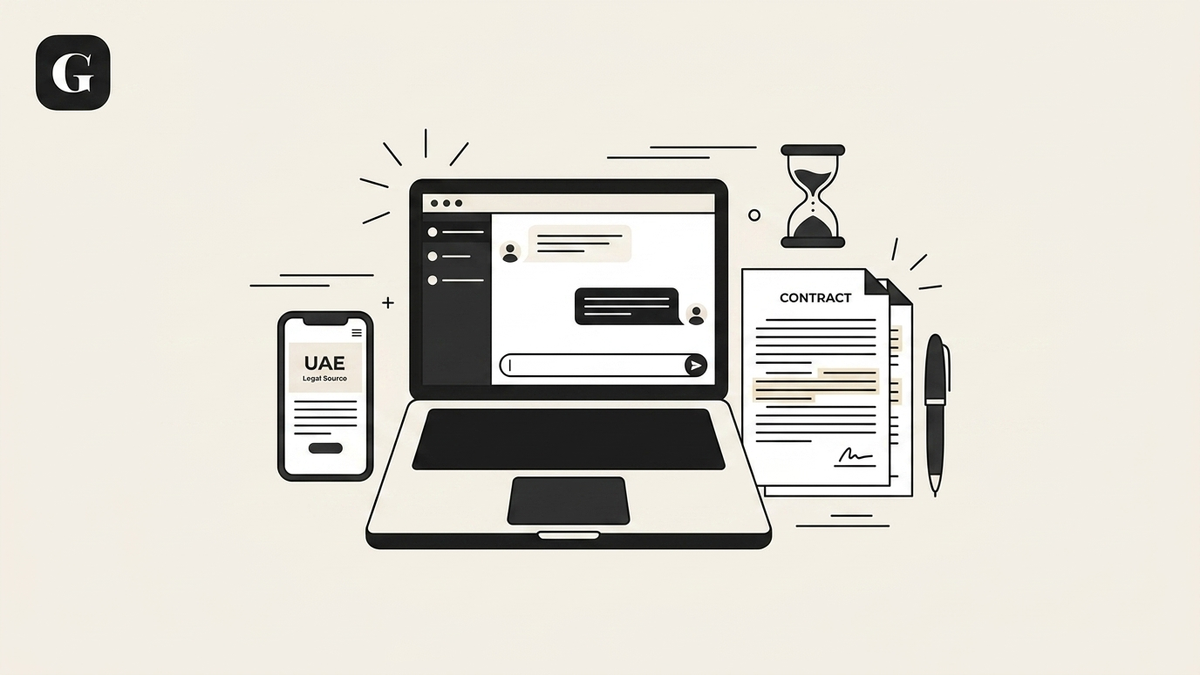
How a Legal Chat Tool Gives Citation-Backed Answers to General Legal Questions in the UAE People who search for legal help online are usually trying to avoid a bad clause, a missed deadline, or a rights issue they do not fully understand. That caution is justified: Wolters Kluwer's 2026 report found that 92% of legal professionals already use at least one AI tool in daily work, which means the question is no longer whether AI is present in legal workflows, but whether its answers can be trusted.
Why general legal questions need jurisdiction, not just text generation
A legal chat tool is only useful when it knows which legal system it is speaking about. In the UAE, that matters more than many users expect, because the same word can carry different consequences in tenancy, employment, free zone, DIFC, or mainland contexts. A generic model may explain a clause in plain English, but it cannot tell you whether that clause maps to UAE law, a particular emirate practice, or a separate regime unless it is built to do that work. This is why general legal questions are not the same as ordinary questions. "Can my landlord increase rent?" sounds simple until the answer depends on the tenancy contract, the applicable emirate rules, and whether the rent cap or notice requirement applies. The job of a strong legal chat tool is not to sound confident. It is to translate the issue first, then identify the legal frame second. That distinction matters because legal users do not need guesswork. They need citation-backed legal answers that show where the answer came from and how closely the source matches the question asked.
What official site citations actually do
The phrase official site citations is not a branding flourish. It is the difference between an answer you can audit and one you cannot. In practice, it means the system points to official UAE sources, then explains the clause, article, or rule in plain language so the reader can check the source for themselves. That matters for three reasons: It reduces hallucinated certainty, because the answer is tied to a source, not a memory. It gives the reader a trail back to the original language, which is essential when a clause turns on a definition. It helps non-lawyers see the gap between the user's question and the governing rule. Forrester's 2025 research gives a useful benchmark for why this discipline matters. It found 344% ROI over three years for large law firms using Lexis+ AI for research, drafting, and related tasks, and 284% ROI for corporate legal teams. Those numbers do not prove every AI answer is trustworthy, but they do show where the value appears: in systems that speed up research while keeping lawyers anchored to primary material.
How citation-backed legal answers work in practice
The best systems do not start by predicting an answer. They start by classifying the question. A UAE legal question about a lease, for example, should be routed differently from a dispute about an employment offer or a shareholder document. Once the question is classified, the tool can retrieve the most relevant official sources, compare them against the user's wording, and produce an answer with citations attached. That process is what makes citation-backed legal answers credible. It forces the model to separate the user's language from the source language. If a user asks, "Can I cancel this reservation?" the tool should not simply restate the contract in softer prose. It should identify the clause that governs cancellation, explain the practical effect, and show the source path that supports the explanation. Graysen, as one example, is built around that confidence-first logic: the value is not that it talks, but that it points back to the rule set it used. The product's real utility is not speed alone. It is helping a user feel sure they are reading the right clause in the right jurisdiction. A 2025 Gartner projection helps explain why this architecture is becoming standard. Gartner estimated that LLMs could lift legal department productivity by 10% to 20% over the next two to five years. That gain will not come from chat alone. It will come from systems that pair natural-language explanations with source traceability and matter-specific routing.
Where legal chat tools go wrong
The biggest failure is overbreadth. A tool that answers every legal question with the same tone and the same source pattern is usually hiding its uncertainty. In the UAE, that is a serious problem because users often mix mainland rules, free zone rules, and informal practice in one query. The second failure is using secondary summaries when the user needs official site citations. A blog post, forum answer, or outdated summary may be useful for orientation, but it is not the same as an official source. If a system cannot separate the two, the user may walk away with a polished answer that is not legally dependable. The third failure is failing to state limits clearly. A legal chat tool should not pretend to be a lawyer. It should say when a question needs human review, especially where contract wording, jurisdiction, or timing could change the outcome. That is not a weakness. It is the mark of a serious tool. Litify's 2024 research showed that 47% of legal professionals were already using AI, with adoption projected to exceed 60% the following year. That kind of growth creates a simple expectation: users will not forgive systems that are fast but vague. They will favor tools that show their work.
What to look for before you trust a legal chat tool
A useful legal chat tool should do four things consistently: Identify the jurisdiction before it answers. Provide citation-backed legal answers tied to primary sources. Translate legal wording into plain language without losing meaning. Flag uncertainty when the question needs a lawyer, not a summary. In the UAE, that also means handling UAE legal questions with jurisdiction awareness. A tenancy issue in Dubai is not automatically the same as a contractual dispute in a free zone, and a bilingual contract may require Arabic-English comparison rather than a straight translation. The tool should respect that complexity instead of flattening it. That is the core point: a good legal chat tool is not a replacement for legal judgment. It is a confidence tool that helps people read clauses correctly, ask better questions, and avoid obvious mistakes before they escalate.
A practical next step Take one contract or one legal question you already have, and ask whether the answer depends on jurisdiction, clause wording, or official source language. If it does, the tool you use should show all three, not just provide a fluent summary.